


Audio reaches more voters, more often, for less money than any other paid channel, and most campaigns still treat it as an afterthought. That gap is the political advantage of audio advertising: the medium delivers, and the competition for it is thin.
Why Audio Is the Channel Political Campaigns Keep Underbuying
Here is the shape of it. Ad-supported audio reaches 81% of voting-age Americans every day, according to Edison Research's Share of Ear study. Radio alone reaches 93% of U.S. adults each month per Nielsen. Yet of the record $11.6 billion AdImpact expects to be spent on political ads this cycle, radio is forecast to take $273 million. That is about 2% of the money chasing roughly four-fifths of the electorate every day.
Television is where campaigns go to be seen. Audio is where voters actually are: in the car on the way to work, in the kitchen, on a job site, on a run. We built NextWave's five streaming stations around that daily listening, and this guide lays out why audio belongs at the center of a campaign media plan in the final weeks before November 3, not at the edge of it.
Where the Political Money Is Going in 2026
The 2026 midterms are on track to be the most expensive election in American history, and almost none of that money is competing for the listener's ear.
AdImpact raised its full-cycle forecast to a record $11.6 billion in late September. Broadcast television has already taken $3.9 billion. Connected TV is at $1.43 billion, digital at $1.1 billion, cable at $900 million. Radio stands at $166 million, with AdImpact projecting $273 million by Election Day, so roughly $107 million of radio buying is still ahead, most of it in October.
Two things follow from those numbers. First, the audio channel is uncrowded. A campaign that buys audio is not fighting a dozen rival spots in the same break the way it is on broadcast TV in a swing state. Second, the money that does arrive is arriving late and fast. Radio spend rose more than 33% in a single month, and AdImpact's historical pattern shows the climb continuing through October. Inventory that is open today will not be open in two weeks.
It is also worth noting who is buying. Across all media, issue groups and outside committees account for $4.87 billion of the tracked spend against $2.48 billion from candidates themselves. Outside groups pay full market rate for audio, which makes early candidate buys the best-priced inventory on the schedule.
Attention You Can't Scroll Past: Why Audio Ads Get Heard
An audio spot is heard because the listener has nowhere else to look. That is the simplest argument for the medium, and it holds up.
Think about how every other political ad is consumed. A TV spot runs while the viewer checks their phone. A pre-roll video gets skipped at five seconds. A display banner is scrolled past before it finishes loading. A mailer goes from the mailbox to the recycling bin. Each of those formats is built on an interruption the audience has learned to route around.
Audio works differently. The listener chose the station, pressed play, and is doing something else with their eyes and hands: driving, cooking, working out, working a shift. The ad plays inside that session, in the same voice and at the same volume as the music they picked. There is no skip button on a streaming station and no second screen to glance at in the car. The message lands whole, usually more than once in the same week.
That is also why audio builds name recognition faster than almost anything else a campaign can buy. A down-ballot candidate's biggest problem is that voters have never heard their name. A thirty-second spot with the candidate's own voice, repeated across a listener's commute for two weeks, fixes that in a way a banner never will. Voters remember a voice. They remember a tone. They remember a candidate who sounded like a neighbor.
Reaching the Voters Other Media Miss
Audio reaches the voters campaigns find hardest to reach anywhere else: the people who are in a car, on a job, or away from a screen for most of the day.
The numbers from this cycle's research make the case. Nielsen's Audio Today 2026 puts radio's monthly reach at 93% of U.S. adults, about 242 million people, with 94% reach among Hispanic adults and 93% among Black adults. Edison Research's Infinite Dial 2026 found online audio reaching 81% of Americans 12 and older in the past month, an all-time high, and the fastest growth is among listeners 55 and older, who went from 52% to 70% monthly reach in two years. Those are the voters who turn out in midterms.
The car is the part campaigns most often overlook. Among Americans who drive, 73% listened to AM/FM radio in the car in the past month and 48% listened to online audio there, more than double the share a decade ago. A thirty-minute commute, twice a day, five days a week, is the most reliable appointment a voter keeps with any medium.
Audio also sorts well by party, which matters when a campaign is choosing where to persuade and where to turn out. Edison's Share of Ear analysis of voting-age Americans found Republicans index at 117 on AM/FM radio, meaning they are 17% more likely than the average adult to listen on a given day. Democrats over-index on ad-supported streaming music, podcasts, and YouTube music. A campaign that wants to reach both ends of that spectrum needs both broadcast and streaming audio in the plan, and a streaming network that spans country, classic rock, new wave, alternative and yacht rock reaches across it with one order.
Format Targeting: Reach a Voter by the Music They Choose
The music a person chooses tells you more about them than a ZIP code does, and audio is the only political channel where that choice is the targeting.
Every station is a self-selected audience. Nobody is assigned to a country station or a classic rock station; they pick it, and they come back to it every day. That makes format a cleaner signal than the demographic buckets campaigns buy on TV, and a more honest one than the inferred interests behind a digital ad. The listener has told you who they are by what they are listening to.
Here is how that plays out across NextWave's five stations:
| Station | Who listens | Why a campaign would want them |
|---|---|---|
| Wild Country Radio | Today's country and country classics; rural, exurban, working-class households | Core turnout audience in rural and exurban districts; highest Republican over-index of any format |
| Rock 'n' Roll Radio | Classic rock, 45 to 70; trades, small business owners, veterans | Older, high-propensity voters who skip streaming video and rarely see digital ads |
| Yacht Rock Radio | Soft rock and easy listening; suburban, 50 and up, high home ownership | Suburban swing voters, especially women 50+, who decide statewide races |
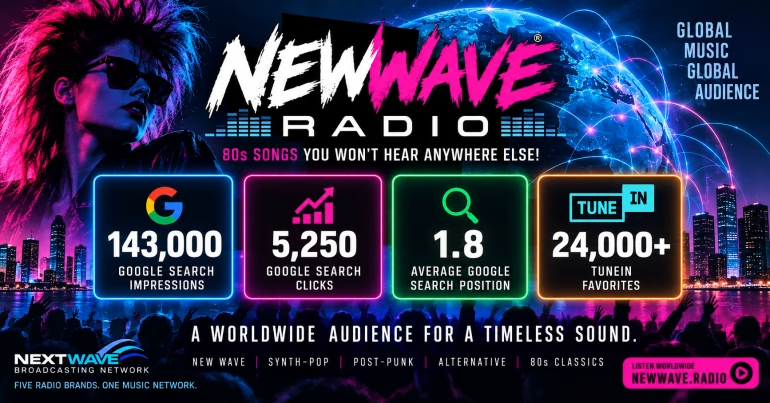
| New Wave Radio | 80s new wave and synth-pop; Gen X, suburban and urban professionals | Persuadable, college-educated Gen X voters in competitive suburban House seats |
| The Alternative One | Modern rock, indie, emerging artists; 25 to 44, urban and college towns | Younger voters who have abandoned linear TV and are expensive to reach on social |
A statewide campaign buys all five and covers the electorate from a single insertion order. A House campaign in a rural district might take Wild Country and Rock 'n' Roll; a suburban challenger might lean on Yacht Rock and New Wave. A ballot-measure committee trying to reach younger renters would start with The Alternative One. The point is that the schedule can be shaped around the voters a campaign actually needs, not around whoever happens to be watching a 6 p.m. newscast.
Streaming Audio vs. Broadcast Radio: What Changes for a Campaign
Streaming audio gives a campaign three things broadcast cannot: geography that follows the listener, measurement that follows the spot, and a schedule that is not bound by a tower's signal.
Geography. A broadcast station covers a signal contour. A streaming station covers wherever its listeners are, and the ad server knows where each stream is playing. A House campaign can run its spot only to listeners inside its district. A statewide campaign can run across the whole state and nowhere else. There is no spill into the neighboring media market and no paying to reach voters who cannot vote for you.
Measurement. Every streaming spot is logged: the station it ran on, the hour, how many sessions it played in. At the close of a flight the campaign gets a delivery report, not a ratings estimate. For a campaign manager answering to a finance director, that is the difference between "we were on the air" and "we delivered 212,000 plays to listeners in the district."
Inventory and schedule. Streaming inventory is not locked into fixed clock breaks, so a flight can go heavier in morning and afternoon drive, where commuters are, and lighter overnight. Copy changes take 48 hours, which lets a campaign answer an attack or pivot to a closing message inside the same week.
Broadcast still has strengths: it is the bigger in-car audience and it carries the familiarity of a local brand. The two are complementary, and a serious audio plan uses both. But for a campaign with a fixed district, a limited budget, and a need to prove where the money went, streaming is the half of the plan that answers those questions.
What a Dollar Buys: Audio Against TV and Digital
A campaign dollar goes further in audio than in any other channel that reaches a mass audience, and in October the gap widens.
Broadcast TV is the most expensive place a campaign can be, and it is getting more so. Kinetiq's September tracking put median October broadcast spot prices at 1.79 times their February-to-May level, because every campaign and outside group in a state is bidding for the same handful of newscast breaks. Connected TV is cheaper per spot but the ad is often playing to a room nobody is in. Digital is cheap per impression and expensive per voter actually reached, because so much of it is skipped, blocked, or served to someone outside the district.
Audio is priced per spot, not per auction. A thirty-second streaming spot costs a fraction of a broadcast TV unit, and a two-week flight on a single station runs for less than one prime-time TV spot in a mid-sized market. Production is light: a script, a voice, a 44.1 kHz MP3, delivered three business days before air. There is no shoot, no edit suite, no reshoot when the message changes.
There is a second cost advantage that is easy to miss. On broadcast radio, outside groups pay roughly three times what candidates pay for the same spot, according to Kinetiq's analysis of FM rates this cycle. That reflects demand: issue groups and super PACs make up most of the fall money and are competing for the same drive-time breaks. Streaming inventory is priced on a published political rate card, and a candidate who books before the final four weeks locks in a rate the late money cannot push up.
For a campaign weighing where the last $25,000 goes, that is the math: one more week of TV in a crowded market, or four weeks of audio across every commute in the district.
Compliance Basics: Sponsor ID, Disclaimers and Deadlines
Political audio is easy to run cleanly if the campaign handles three things up front: the disclaimer, the creative deadline, and the paperwork.
Sponsor identification. Every political spot and every digital placement must carry the "Paid for by" line the law requires. For federal candidates that means the FEC disclaimer, read in the spot and shown on the digital creative. State and local races follow their state's rules, which vary. The advertiser is responsible for the wording; we will not run a spot without it.
Who can buy. We accept advertising from legally qualified candidates, parties, committees and advocacy organizations regardless of party or position. We may decline a spot that is defamatory or misleading about how, when or where to vote.
Deadlines. Insertion orders are due five business days before the first air date. Audio creative (MP3, 44.1 kHz, with sponsor ID) and digital creative (1200 by 630 and 300 by 250 images plus a landing page) are due three business days before. Flights are prepaid before the first spot airs. Mid-flight copy changes take 48 hours. In the final four weeks before an election, inventory is first-come, first-served.
One difference from broadcast. NextWave's stations stream online and are not FCC-licensed broadcast stations, so the FCC's lowest-unit-charge rule and political-file requirements do not apply to our rates. Political pricing is set on our own rate card, published and the same for every qualified candidate. Buyers used to broadcast rules should expect a rate card by daypart and class, and they will get one.
This is a summary, not legal advice. Campaign counsel should confirm disclaimer wording for the specific race.
A Four-Week Audio Plan for the Final Stretch
The last four weeks before Election Day are when audio does its best work, because that is when voters are deciding and when every other channel is at its most crowded. Here is how we would build it.
- Weeks 4 and 3: name and message. Run a thirty-second introduction spot, in the candidate's own voice, across the formats that match the district. The goal is recognition. Keep the message to one idea and say the candidate's name three times. Pair it with homepage and in-app placements on the same stations so the name is seen as well as heard.
- Week 2: contrast and proof. Rotate in a second spot that draws the contrast with the opponent or makes the case on the one issue the race turns on. This is the week to use the 48-hour copy change if the opponent has gone on the attack.
- Week 1: turnout. Shift the final flight to a get-out-the-vote spot: where to vote, when polls close, early-voting hours. Weight it heavily into morning and afternoon drive, when the listener is already in the car and could go vote on the way home.
- Election Day. Keep a light schedule running through the close of polls. Audio is the one channel that reaches a voter while they are driving to the precinct.
Three packages cover most of this. A District flight runs two stations for two weeks. A Statewide flight runs all five stations for three weeks. An Election Day Push covers the final fourteen days. Each runs on one insertion order across streaming audio, the station websites and apps, and social, and each closes with a delivery report.
Two practical notes. Book before the final four weeks if the race allows; after that, inventory is first-come, first-served and the late outside money is competing for the same hours. And produce the creative early. The spot that wins is usually the one that was ready a week before it was needed.
Put Your Campaign in Front of Listeners Who Choose What They Hear
The advantage of audio is not that it is cheap, though it is. It is that a voter hears a candidate's own voice, in the car, in a session they chose, with nothing else competing for their attention. No other political channel can say that, and in 2026 almost no campaign is using it to the full.
NextWave Broadcasting Network runs five streaming stations, Wild Country Radio, Rock 'n' Roll Radio, The Alternative One, New Wave Radio and Yacht Rock Radio, reaching about 3.5 million unique listeners a month across 302 U.S. markets. Each station also runs its own website and mobile app, which together draw about 50,000 visits a month per site and an estimated 500,000 page views across the network, so a campaign's message is seen on screen as well as heard in the stream.
We sell streaming audio spots by daypart, station and show sponsorships, homepage and sponsored-content placements, and network packages that bundle all of it under one insertion order. We can write and voice the spot. And we reply to every inquiry within one business day.
Request the Political Rate Card & Book a Flight
Or contact us and tell us the race, the geography and the dates. We will take it from there.
Sources
- AdImpact forecasts $273 million in radio spending during 2026 midterms — Barrett Media, Sept 28, 2026
- Radio political spending accelerates, with biggest weeks ahead — Inside Audio Marketing, Sept 2026
- Radio reclaims political ad share as October buying approaches — Inside Audio Marketing / Kinetiq, Sept 2026
- Audio key to reaching 2026 voters — Edison Research at SSRS, Share of Ear, July 30, 2026
- Nielsen: Radio still leads U.S. audio reach in 2026 — Nielsen Audio Today 2026, March 2026
- Infinite Dial 2026: Radio's biggest audience is going digital — Edison Research, March 2026