-
play_arrow
The Alternative One Your Modern Rock Music Radio Station!
-
play_arrow
Wild Country Radio Your Hometown Country Music Station...
-
play_arrow
Rock ‘n’ Roll Radio We Play Everything That Rocks Your World!
-
play_arrow
Yacht Rock Radio Nothing but Smooth Breezes Ahead...
-
play_arrow
New Wave Radio 80s Songs You Will Not Hear Anywhere Else!
-
 play_arrow
NextWave Broadcasting Network Advertising NextWave Broadcasting Radio Group Network
 Rational Youth - Heredity
Enjoying your curated playlist from Montreal, Canada!😎
Johnnie Superstock
Rational Youth - Heredity
Enjoying your curated playlist from Montreal, Canada!😎
Johnnie Superstock
 Public Image Ltd. - Disappointed
To New Wave Radio - The greatest!!
Public Image Ltd. - Disappointed
To New Wave Radio - The greatest!!

By NextWave Broadcasting Network · Updated October 11, 2026
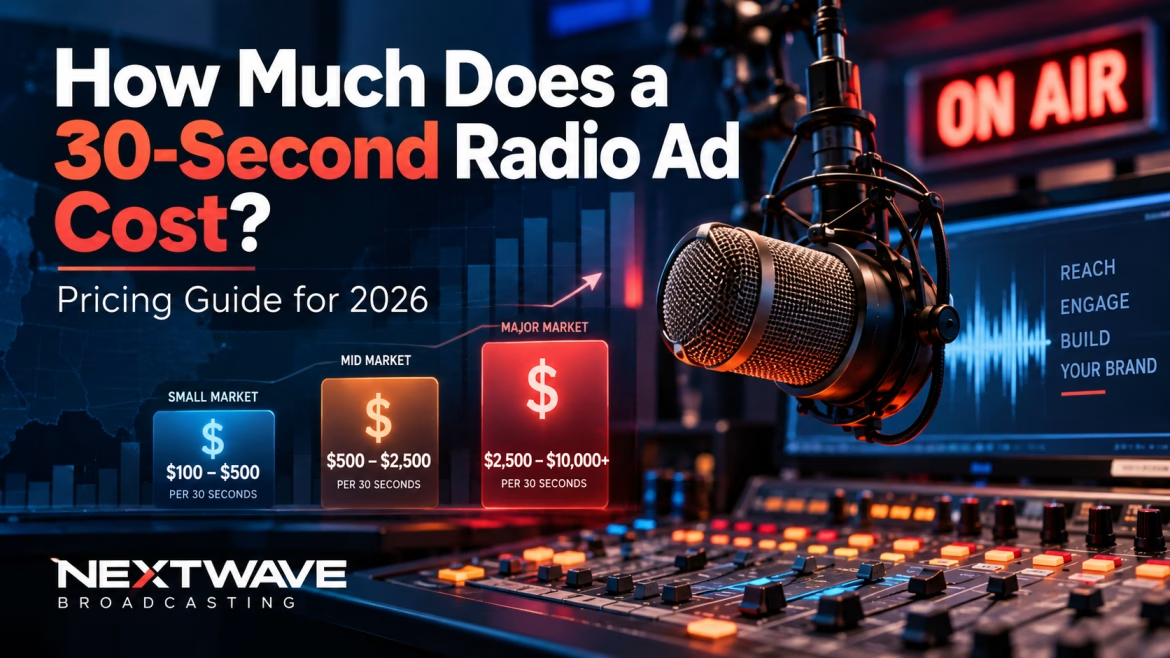
How Much Does a 30-Second Radio Ad Cost in 2026?
A 30-second radio ad can cost anywhere from under $25 per spot on a small-market station to well over $1,000 per spot in a major market during peak hours. Published estimates span roughly $25 in a market like Topeka, Kansas to more than $1,400 in New York City. Streaming audio is usually sold by the thousand impressions (CPM), with commonly quoted rates in the high single digits to about $30 CPM depending on targeting.
The price of a single spot matters less than the cost of a schedule that reaches enough people enough times. This guide explains what drives the price, how to calculate it and how to budget a campaign that can actually work.
Key takeaways
- Per-spot prices range from tens of dollars in small markets to $1,000+ in top markets at peak times.
- A :30 is commonly priced at about 60–70% of a :60 on the same station.
- Evening and weekend spots can cost up to 75% less than prime dayparts.
- Streaming audio is bought by CPM and can be targeted by geography, device and audience.
- Budget for a full schedule with enough frequency, not a handful of spots.
Typical 30-Second Radio Ad Price Ranges
Radio rates are negotiated, seasonal and station-specific, so treat any published figure as a starting estimate. These ranges reflect commonly reported pricing:
| Market / format | Typical cost per :30 spot | Notes |
|---|---|---|
| Small market station | About $20–$100 | Lower audience, lower rates; good for local businesses. |
| Mid-size market | About $100–$500 | Varies sharply by station rank and daypart. |
| Top-10 market, peak daypart | About $200–$1,000+ | Estimates for New York exceed $1,400 per :30. |
| Streaming audio (digital radio, music apps) | Priced by CPM, roughly $8–$30 | Targetable by geography and audience; budget scales up or down easily. |
Ad length changes the math too. Industry pricing guides commonly put a :30 at about 60–70% of the cost of a :60, and a :15 at roughly 60% of a :30. A 30-second script runs about 75–85 spoken words.
How Radio Ads Are Priced: Spot Rates, CPM and CPP
- Per-spot rate. The station quotes a price for each airing, usually varying by daypart. Most local buys are sold this way, often in packages.
- CPM (cost per thousand). What it costs to deliver 1,000 impressions or listeners. Streaming audio is almost always sold on CPM; broadcast buyers use it to compare stations.
- CPP (cost per point). Agencies buying ratings-based broadcast schedules compare stations by the cost of one rating point in the target demographic.
- Sponsorships and live reads. Show sponsorships, features and host-read endorsements are typically priced as packages and often cost more per mention because of the added credibility.
To translate CPM into a spot price, use: cost per spot = CPM × (audience reached ÷ 1,000). A spot reaching 50,000 listeners at a $12 CPM costs $600.
Broadcast vs. Streaming Radio Pricing Compared
“Radio” now covers two buying models. Many campaigns combine them, so it helps to see how each is priced:
| Broadcast AM/FM | Streaming radio & digital audio | |
|---|---|---|
| How it’s sold | Per spot, by daypart, often in weekly packages | Per thousand impressions (CPM), sponsorships and packages |
| Minimum budget | Varies by station; often a weekly or monthly minimum | Flexible; scales with the number of impressions |
| Targeting | Market, station format, daypart | Station format plus geography, device and time of day |
| Delivery proof | Station affidavit or air-time log | Impression and delivery reports |
| Clickable elements | None in the audio itself | Companion banners and tagged links where offered |
| Best fit | Mass reach in a single metro, in-car listening | Multi-market reach, precise budgets, measurable tests |
Because streaming is bought by impressions, the “cost of a 30-second ad” is really the cost of the impressions you choose to buy. A $1,000 budget at a $15 CPM delivers about 66,700 impressions; the same budget at $25 delivers 40,000. Tighter targeting usually means a higher CPM but less waste.
Quick Radio and Streaming Ad Budget Calculator
Estimate a monthly budget from audience size, CPM and the number of spots you plan to run. Rates are illustrative; ask for a quote to get actual pricing.
| Estimated cost per spot | – |
| Estimated weekly cost | – |
| Estimated campaign cost | – |
| Total impressions delivered | – |
Illustrative estimate only. Actual rates depend on station, daypart, season and package.
What Drives the Cost of a Radio Ad?
- Market size. Bigger metros mean bigger audiences and higher rates.
- Daypart. Drive times and middays command premium rates. Evening and weekend spots can cost up to 75% less than prime time, according to Barrett Media’s radio-buying guidance. See best dayparts for radio advertising.
- Station ranking and format. Highly rated stations and in-demand demographics cost more.
- Seasonality and demand. Q4 holiday retail and election years tighten inventory. On broadcast stations, federal rules give qualified political candidates the lowest unit charge in the 45 days before a primary and 60 days before a general election, while heavy political demand pushes other advertisers’ rates up.
- Spot length and placement. :60s cost more than :30s; fixed-position or first-in-break placements carry premiums.
- Schedule size and commitment. Longer flights and larger packages usually earn better rates.
How Radio’s Cost Per Thousand Compares With Other Media
Comparing cost per spot with cost per click is apples to oranges. CPM puts channels on the same footing:
| Channel | Typical CPM range quoted for 2026 | What you get for it |
|---|---|---|
| Streaming audio | About $8–$30 | Ads heard in full in a music environment; targetable |
| Meta (Facebook / Instagram) | Median roughly $14–$20, higher in competitive industries | Feed impressions with precise targeting; easy to scroll past |
| Connected TV | About $15–$40 | Big-screen video; higher production cost |
Broadcast radio has long been one of the lowest-CPM mass media, which is why it is often used to build frequency affordably. CPM alone doesn’t decide value, though: attention, audience fit and measured return matter more. See radio vs. social media ads ROI for the full comparison.
Don’t Forget Production Costs
Media is only part of the budget. Production options range widely:
- Station-produced spots are often included or low-cost with a schedule.
- Professional voice talent typically runs from a few hundred dollars per spot upward, depending on usage rights and talent.
- Agency or studio production with original music, multiple voices and sound design can reach the low thousands.
- Live reads and host endorsements use the station’s talent and are priced into the sponsorship.
Plan to produce two or three versions of your ad so you can rotate creative and avoid wear-out over a longer flight.
Political Advertising and Radio Rates
Election years change radio pricing more than any other season. Three things are worth knowing:
- Lowest unit charge on broadcast. Under FCC rule 47 CFR 73.1942, broadcast stations must charge legally qualified candidates no more than the station’s lowest unit charge for the same class and amount of time during the 45 days before a primary and the 60 days before a general election.
- Inventory gets tight. Political demand can sell out premium dayparts, pushing commercial advertisers into other times or raising their rates.
- Streaming is booked differently. Digital and streaming audio inventory is not subject to the broadcast lowest-unit-charge rule and is typically sold on CPM, which gives campaigns and issue groups flexible, geo-targeted reach. Disclosure requirements still apply, so confirm the “paid for by” language with counsel.
Commercial advertisers planning around election season should book early or shift weight to streaming. Campaigns can learn more on our political advertising page.
Sample Monthly Radio Budgets
The illustrations below show how spot price and frequency interact. They assume a 4-week month and are not a quote.
| Goal | Example schedule | At $50/spot | At $200/spot |
|---|---|---|---|
| Maintenance presence | 20 spots/week | $4,000/mo | $16,000/mo |
| Sales event / promotion | 40 spots/week | $8,000/mo | $32,000/mo |
| Launch / major event | 70 spots/week | $14,000/mo | $56,000/mo |
The right number of weekly spots depends on the station’s audience turnover and your goal. Our guide to how many times a radio ad should run shows how to size it.
Example: Budgeting a First Radio Campaign
Here is how a regional business might plan a four-week test, step by step:
- Set the goal: 50 incremental quote requests.
- Choose the audience: adults 35–64 in two metro areas, reached through a classic rock and a yacht rock stream.
- Size the frequency: aim to reach listeners about three times a week (see how many times a radio ad should run).
- Price it: 250,000 impressions per week at a $15 CPM = $3,750 per week, or $15,000 for four weeks.
- Add production and tracking: about $500 for a professionally voiced :30 in two versions plus a vanity URL and call-tracking number.
- Define success: at 50 incremental leads, the cost per lead is about $310. Compare that with your average gross profit per customer to decide whether to scale.
The numbers above are illustrations, not a quote. The method is the point: start from the goal, size frequency, then price the schedule.
Radio Budgeting Mistakes That Waste Money
- Buying spots instead of outcomes. A low per-spot price is no bargain if the schedule is too light to reach anyone more than once. Price the schedule needed to hit your frequency goal, then decide whether it is worth it.
- Spreading a small budget across too many stations. Each station’s audience needs repetition. Two stations at high impact beat five at minimum levels.
- Skipping production quality. A clear script and a professional voice cost little relative to media, and weak creative wastes every dollar behind it.
- Stopping after two weeks. Audio builds familiarity over repeated exposures; plan four weeks or more before judging results.
- No tracking plan. Without a vanity URL, a code, call tracking and a baseline, you can’t tell what the budget returned. See how to measure radio ad campaign ROI.
- Ignoring the calendar. Booking late in Q4 or an election season means paying more for less.
Is Radio Advertising Worth the Cost?
Cost per spot is only meaningful next to results. Nielsen’s 2026 Audio Today report, citing its Global Compass benchmarks, places radio’s weighted return at about $2 per dollar spent, second only to social media. Radio also reaches large audiences at a low cost per thousand compared with many visual media. To know whether it is paying off for you, see how to measure radio ad campaign ROI and radio vs. social media ads ROI.
How to Get More Value From Your Radio Budget
- Commit to a longer flight. Multi-week and annual commitments typically earn better rates than one-off weeks.
- Mix dayparts. Anchor the schedule in prime times and extend frequency with lower-cost evenings and weekends.
- Use :30s and :15s. A :30 is usually enough to deliver one clear message and a call to action at a lower cost than a :60.
- Ask about added value. Station website placements, social mentions, newsletter inclusion or event tie-ins are often bundled with schedules.
- Avoid peak-demand weeks unless your sale depends on them; holiday and pre-election weeks cost more.
- Concentrate spending. Enough frequency on fewer stations beats a thin schedule spread across many.
- Measure from day one so you can move budget to what works. See tracking radio conversions in GA4.
How NextWave Prices Streaming Radio Campaigns
NextWave Broadcasting Network sells streaming audio, station and show sponsorships, website placements and custom campaigns across five digital music stations, with a published network reach of 3.5 million monthly unique listeners across 302 U.S. markets (reported May 1, 2026). Campaigns are built around your goal, target listeners and flight dates, so you can start with one station or combine formats. Contact our sales team for a custom quote.
Ready to put radio to work for your business?
NextWave Broadcasting Network reaches music fans across five digital stations, with a published network reach of 3.5 million monthly unique listeners across 302 U.S. markets (reported May 1, 2026). Tell us your goal and budget and we’ll build a schedule with the reach, frequency and tracking to prove results. Email [email protected].
Frequently Asked Questions
How much does a 30-second radio commercial cost?
Expect roughly $20 to $100 per spot in small markets, a few hundred dollars in mid-size markets and $1,000 or more in the largest markets at peak times. Streaming audio is typically priced by CPM, commonly about $8 to $30.
Is a 30-second radio ad cheaper than a 60-second ad?
Usually. Industry pricing guides commonly put a 30-second spot at about 60 to 70 percent of the cost of a 60-second spot on the same station.
What is the cheapest time to run a radio ad?
Evenings, overnights and weekends are generally the least expensive dayparts. Industry guidance notes these spots can cost up to 75 percent less than prime time.
How much should a small business spend on radio advertising?
Budget for a full schedule that reaches a meaningful share of the audience several times a week for at least four weeks. In smaller markets that can start in the low thousands per month; in large markets it is higher.
Does the price include producing the commercial?
Sometimes. Many stations produce basic spots as part of a schedule, while professional voice talent or agency production is billed separately.
How is streaming radio advertising priced?
Streaming audio is usually sold by CPM, the cost per thousand ad impressions, which makes budgets flexible and lets you target by geography and audience.
Are radio ad rates higher during election years?
Often, yes. Political demand fills premium inventory, and broadcast stations must offer qualified candidates their lowest unit charge before elections, which can squeeze availability and raise rates for commercial advertisers.
What is a good starting budget for streaming radio ads?
Because streaming is bought by impressions, budgets are flexible. Size the budget from the impressions needed to reach your audience about three times a week for at least four weeks, then multiply by the CPM.
More Radio Advertising Guides
Sources
- Fit Small Business: Radio advertising costs by location
- Ad Results Media: How much do radio ads cost
- Wondercraft: How much does it cost to make a radio ad
- Barrett Media: How many radio ads should advertising clients run?
- GrowthSpree: Podcast and audio advertising benchmarks 2026
- Radio Ink: Nielsen Audio Today 2026
- eCFR: 47 CFR 73.1942, candidate rates
- AdManage: Facebook CPM benchmarks 2026
- C&I Studios: 30-second commercial cost 2026 (CTV CPM ranges)
2026 Copyright NextWave Broadcasting - Social ToothPaste Media Agency